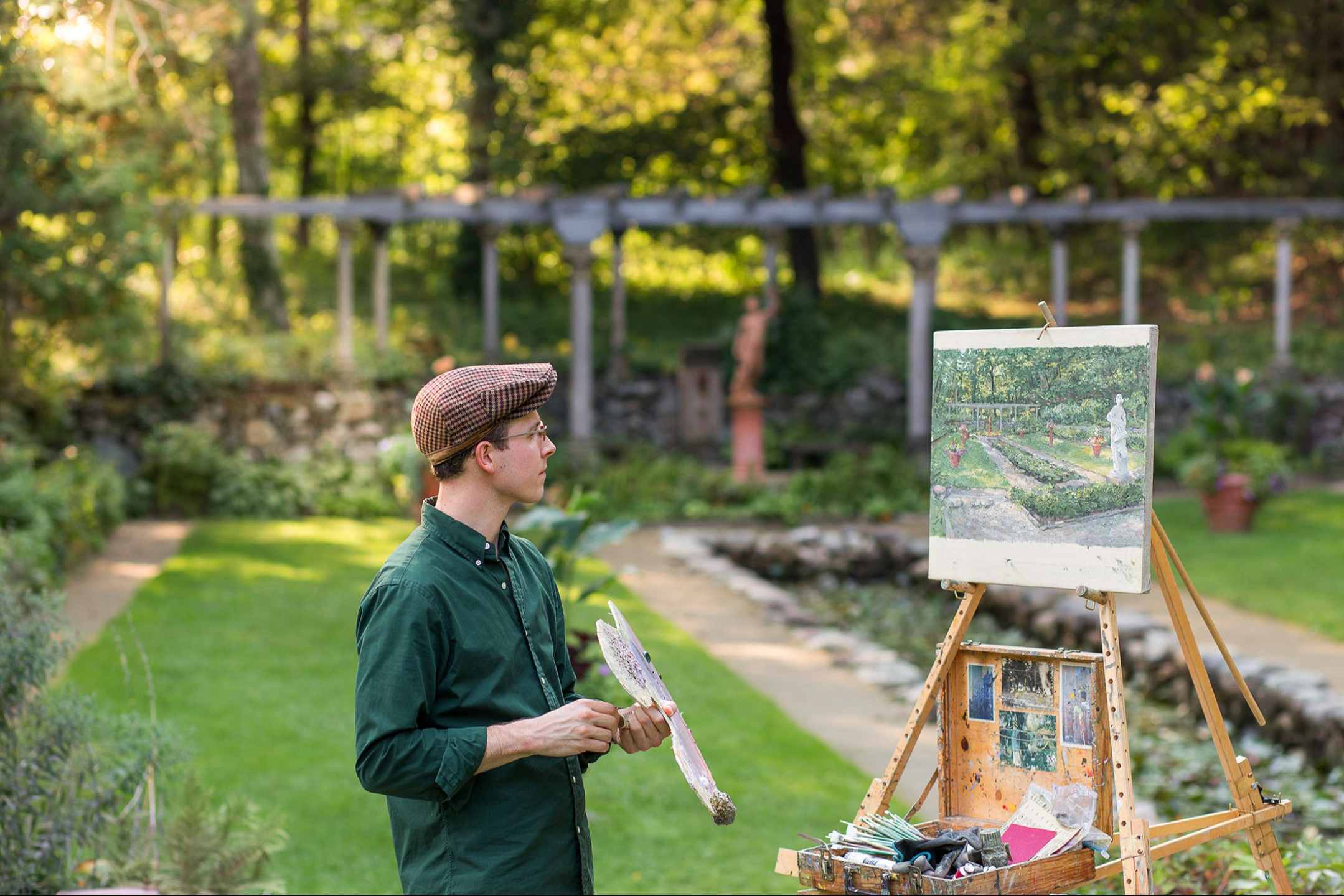
Capturing Texas Wildflowers En Plein Air: The Making of "Austin Awakening"
Jun 02, 2015For Mary McDonald, the blooming wildflowers of Texas Hill Country are a heaven on earth that happens once every spring. The lush arrangement of rich colors blooming all along the highways and byways of Austin are like a breath of fresh air and peacefulness that she looks forward to with anticipation during the cooler months of winter.
When she commissioned me to do this piece for her she wanted it done right... so she had me come to Texas to paint it from life. It was an extraordinary pleasure for me to bring this painting to life for her. Everything from traveling to Texas, to finding the location, to painting the bluebonnets, Indian paint brushes, Indian blankets, and evening primrose wildflowers with the backdrop of Austin's Hillside in the background was an absolutely awesome experience.

Hey everybody, this is Dustin Neece here. It's a rainy Tuesday and I thought we'd hang out in my studio and I'll show you my time lapse video of the creation of my painting of Texas wildflowers.
First of all, thank you for all the comments I got on my Boston Public Garden composition. I'm psyched about being out there all summer and hope you guys come to visit me. That would be awesome.
Behind me, you can see that we're literally actually just in my studio and I'm kind of showing you what I got going on here. This painting is my spring / summer transition painting.
Normally I don't show something that's in the middle of being worked on. But, I thought I'd put it up so you can see what I've been up to lately. So, enjoy! You can let me know what you think of that, that'd be awesome.
Before I start showing you the time lapse video and doing the commentary, I did want to just answer one quick question. Somebody sent me an email and asked me if I was gonna talk about all the personal stuff behind my paintings.
I will do that, but I'm gonna do that in the next video that I send out and show you the finished painting of my Texas wildflowers, all finished and in the frame and unveil it properly. So you can look forward to that. But for now, let's dive in and you can see me do a one month or six week painting in just a couple minutes. Alright, here we go.
Okay, so you can see the first thing that I do is start with this charcoal outline and, just start to fill it in and map it out.
As you're watching this time lapse, I want you to keep in mind that this painting came out of nothing. When I went down to Texas and I met with my patron Mary, she said, "I want a painting of Texas wildflowers and I want it to capture the feeling that you get when you're driving down the highway and all these amazing, beautiful varieties of wildflowers are coming in on the median."
I thought to myself, "Okay, that's great, but I'm not going to set up and do this painting on the highway in the middle of the median."
When I design a painting, the impulse for the creation of it, the idea, it either comes from me or it comes from my patron, the person who's commissioning it. And in this case, I had to kind of guess, ask the right questions and really get a sense of what is the essence of what this person wants. What is it? What is the feeling that they want to get from it?
Mary was really helpful and really descriptive: she wanted it to capture a feeling of openness and the feeling of springtime, new possibilities and just this really wonderful open feeling that you get when you see all the wildflowers come in.
It really is a beautiful event that happens in Texas every year. Being from New England, I was only familiar with our fall foliage. So this was like a whole new thing for me to go to a place where the botanical event was so different.
It was really very cool. But the first thing I had to do is you'll notice that there's a house in the background and this property that I'm on is actually just private property. It's not even a public place and people wonder: "okay, you spent two months there, you only made one painting", we forget that, yes, there was the idea for the painting, but one of the first steps was even finding the location that suited the feeling that I wanted the painting to evoke. And that process took a week just to begin with.
I literally drove around to every public park in a half hour radius around Austin to try and see if there was a public place where I could do this, and nothing quite fit. I actually found this property by accident and it's absolutely gorgeous. And you can see as I work on it here that the whole entire yard is absolutely covered in these bluebonnets, which is the state flower of Texas. I mean, look at that. It's like that's the whole thing in every direction is just all saturated with these beautiful purple blue flowers.
Sometimes you just have to hold the idea and move forward and drive around a lot and hope for the best. I was really lucky to find this spot and also to have the people that live there say, "yeah, you can come here and paint every day for a month."
So anyway, that really came together.
So now you can see at this stage of the painting, I've already gone through developing all the detail, but now I'm trying to figure out the true, let's say, the focal point or the center of the painting, which for me is that hillside right in the upper right hand corner of the painting where the sky meets the land and there's this opening in the tree line is really like the focal point or the entry point of the painting visually where I want everything to point to. When I first started the painting I really I had no idea where the center of it was and what the focal point was going to be.
I know a lot of people would much prefer to work on a painting where they have more, let's say, control, where they're working from a photograph or they have a very fixed design right from the beginning, but for me, I want it to be open.
It's like life.
If you knew everything that was going to happen to you for the rest of your life or even for the next couple of years, would you want to know?
I love that question because we get so worried about what's going to happen next and is everything going to be okay and is this going to work out?
If you sit down and you ask yourself, "would I want to know how everything happens and how everything works out?"
I don't. For me the answer is: "no way." That's part of the enjoyment of life.
For me, the creative process is not knowing what's going to happen next.
So when I'm working on a painting like this, it's a process of discovery and it's very organic.
I don't know what the final product is going to look like, and I don't want to know until I put those final brushstrokes on the canvas.
So you'll see that as I'm moving around and making all these different brushstrokes all over the painting, it's like I'm molding it, I'm shaping it.
I'm not just filling it in or creating every perfect flower and once it's all filled in, it's done. No, it's all about: what does the painting need next to be the fullest and grandest expression of itself that it possibly can be.
You start out with this this kind of abstract idea, right? Then you start to fill it in.
In the beginning, it's a poor representation of what you want it to be in your mind. It takes a lot of work and a lot of refining over and over and over and over again to really distill the painting down to its essence and make the physical painting as close a representation of the essence of the idea and the feeling that you had in the beginning.
So you can also see that I'm actually working on it in her house right now. I normally don't do that.
Normally I work outside all the time. But part of the cool thing about this painting was that I knew exactly the room that it was going to be in and I knew the other paintings that she had in her collection. I wanted to custom tailor it to fit her space, her home, because she's the one that's going to live with it, forever. So part of the process was taking place in her house and in her space because, again, it was such a custom piece.
So this is the final session and you can see that I actually did have to, at some point, set up on the side of the highway just to get all the different colors in place and find a place that had the pinks and yellows and the reds that I was looking for in the painting as well.
This is one of the advantages of working from life. I remember reading a book of Andrew Wyeth and he said that rarely in any of his landscapes was he ever just in one spot.
So there I am signing it and that's the end of it.
So anyway, this whole idea of moving around, even this painting that you see behind me right now is not exactly what that spot looks like.
It's not necessarily about getting it perfectly accurate like a photograph, but getting the essence of that thing and making the physical representation of the essence of it, not just 'exactly' what it looks like. We have cameras for that.
Painting for me is about capturing the essence. The essence of it is not just the picture, the pictorial aspect of it, the pictorial essence of it, but also the human experience of it.
The human experience is not just what it looks like, but what it feels like.
So I try to stay open in all of my paintings and all of my compositions so that that human feeling essence aspect can come through and can recreate the actual experience of being in that place or for this painting, driving down the highway in the springtime in Austin, Texas, in Hill Country and seeing all these beautiful varieties of flowers coming in together.
So anyway, that's the painting. And you can already see what the final version of it looks like, but I am going to send you another video where I'll talk just a little bit more about what the painting was for me, and I'll show you what it looks like in the frame. And I'll also send you the high resolution download of it so that you can enjoy it at home on your computer, put it on a note card, whatever you like.
So have a great week and I'll talk to you soon.
Join My Mailing List
Join my mailing list to receive my letters, see new paintings, and be invited to the next show.
Your information will never be shared or sold for any reason.